
Educational, not advice. This article explains a change TransUnion is making to the credit scores it shows consumers in the UK. It is general information, not personal financial advice, and it does not recommend any credit product, app or provider.
What this article covers: the new TransUnion score and bands, why your number will look different, when you will see it, and what it does and does not change.
What it does not cover: how to improve a particular score, or whether you are likely to be accepted for credit. Only a lender can answer the second.
In short
- TransUnion is moving its UK consumer score from 0 to 710 to 0 to 999, rolling out across the apps and websites that use its data from late September 2026 to June 2027.
- It is a new score, not just a new scale. It uses how you have managed credit over time, not a single snapshot, so you can’t convert your old number.
- The bands are renamed. “Poor” and “Very Poor” become “Low” and “Very Low”. “Good” is now 653 to 785, and “Excellent” is 786 to 999.
- Most people stay in the same band. MoneySavingExpert reports 58% stay put, 36% move up and 6% move down.
- Lenders’ decisions don’t change. TransUnion says the information in your credit report is not changing, and lenders use your report, not this score.
- You may see two TransUnion scores for a while, depending on when the app you use switches over.
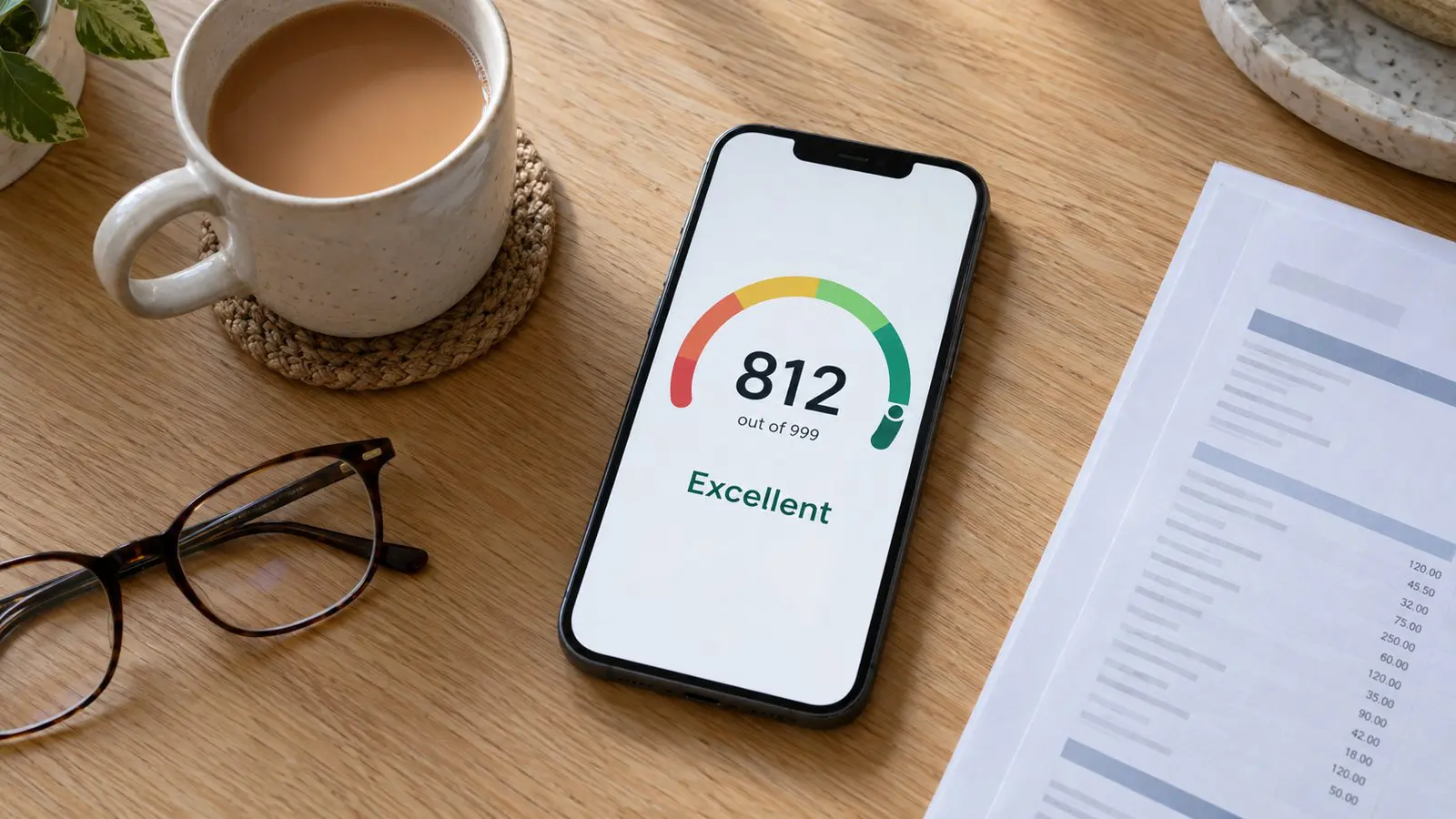
If you check your credit score in an app, don’t be surprised if the number jumps. TransUnion, one of the UK’s three main credit reference agencies, is replacing the score it shows consumers. The old one ran from 0 to 710. The new one is a TransUnion credit score out of 999, with new band names and a new way of working out where you sit.
A bigger number doesn’t make you a better borrower overnight, and a change of band doesn’t mean something has gone wrong. Here is what is changing, and what isn’t.
What is TransUnion changing about its credit score?
TransUnion announced the change on 26 August 2026. The obvious part is the wider range: 0 to 999 instead of 0 to 710. The less obvious part is that the score itself is new. In TransUnion’s words: “This is more than a new number range, it is a new score incorporating trended data and combining how consumers use credit over time with a moment in time view.”
Put simply, the old score leaned on a snapshot of your credit file. The new one also looks at direction of travel: how your balances have moved over time and how you use your credit cards. TransUnion also says it does a better job with people who have little or no credit history, such as those new to credit, instead of lumping them in with people who have a poor record.
What is a good TransUnion credit score out of 999?
These are TransUnion’s own figures, from its announcement.
| Band (old) | Old range (0 to 710) | Band (new) | New range (0 to 999) |
|---|---|---|---|
| Excellent | 628 to 710 | Excellent | 786 to 999 |
| Good | 604 to 627 | Good | 653 to 785 |
| Fair | 566 to 603 | Fair | 563 to 652 |
| Poor | 551 to 565 | Low | 488 to 562 |
| Very Poor | 0 to 550 | Very Low | 0 to 487 |
So a “good” TransUnion credit score out of 999 is 653 to 785, and anything from 786 up counts as “excellent”. The bands are also far wider than before. The old “Good” band was 24 points wide. The new one spans 133.
Why has my TransUnion credit score changed?
The temptation is to scale the old number up: multiply by 999, divide by 710. It doesn’t work. The new score is calculated differently, so two people with the same old score can land in different places on the new one.
That is why some people change band. MoneySavingExpert reports that just over a third (36%) will move into a higher band, over half (58%) will stay where they are and 6% will drop into a lower one. Those figures aren’t in TransUnion’s own announcement, so treat them as MSE’s reporting rather than an official breakdown.
If you are one of the 6%, the reason matters. A lower band under the new model reflects how it weighs the same information, balances that have crept up over time, for example. It is not a new mark against you. Nothing has been added to your credit history because the score changed.
Does the new score affect mortgage or loan applications?
No, according to TransUnion. Its announcement is unusually blunt on the point: “It is important to note that whilst the consumer credit scoring is changing this does not impact lender decisions and the underlying credit information contained within a credit report is not changing. Lenders use a consumer’s credit report alongside their own factors to determine lending decisions. For this reason, consumer’s financial applications will not be impacted by the score change.”
This is the bit most people get wrong about credit scores generally. The number in your app is a guide for you. A lender looks at your credit report, the record of your accounts, repayments and searches, and runs it through its own scoring alongside what you tell it about your income and outgoings. James Robinson, TransUnion UK’s managing director of consumer interactive, puts it plainly: there is “significant confusion among consumers about what credit scores mean, with many believing the score they see is the same one used by lenders.”
So if you are partway through a mortgage application, a change in your TransUnion number this autumn is not something the lender will see or act on. What counts is what is in the report. If you want to know what lenders see, that is where to look.
When will you see your new TransUnion score?
It depends on where you check it. TransUnion says the new score “will roll out across credit monitoring partners on a phased implementation from late September 2026 until June 2027.” Each app or website switches when it is ready, and TransUnion hasn’t published a timetable by provider.
That makes for a quirk over the next few months. Use more than one service that draws on TransUnion data and one may show the new score while another still shows the old. TransUnion confirms “some consumers may temporarily see two different TransUnion credit scores”, and that the difference won’t affect lenders.
Not every credit app uses TransUnion. Each of the three agencies has its own data and its own scale, and apps usually say which one they draw on. If yours shows a score out of 999 and you aren’t sure whose it is, check before comparing it with anything.
How does it compare with Experian and Equifax?
If this feels familiar, that is because Experian did much the same a year earlier. It began a gradual rollout of a new score out of 1,250 in autumn 2025, also with softer band names. Equifax’s score runs from 0 to 1,000.
So the three agencies now use three different scales, and a number from one means nothing on another. A score of 800 is “Excellent” at TransUnion but would sit in a lower band on Experian’s 1,250 scale. Compare each agency’s score with its own bands only, and with your own previous score from the same agency once it has switched.
What to keep an eye on
- The band, not the number. After the switch, your band tells you more than the raw figure, which is bound to look different.
- The report behind it. If your band drops and you don’t know why, the report is where the answer sits: accounts you don’t recognise, payments marked missed that weren’t, old addresses. Errors are worth correcting whatever the score says.
- Like with like. Only compare new TransUnion scores with new TransUnion scores. The old 0 to 710 history in your app won’t line up with the new one.
If you are in the US
This change is UK-only. TransUnion is also one of the three US credit bureaus, but US lenders mostly rely on FICO and VantageScore models, and a FICO Score still ranges from 300 to 850. Nothing in TransUnion’s UK announcement touches US scores.
Common questions
Why has my TransUnion credit score changed?
Almost certainly because the app you use has switched to TransUnion’s new score, which runs from 0 to 999 instead of 0 to 710 and is calculated differently. The rollout runs from late September 2026 to June 2027.
What is a good TransUnion credit score out of 999?
TransUnion’s new “Good” band is 653 to 785, and “Excellent” is 786 to 999. “Fair” is 563 to 652, “Low” is 488 to 562 and “Very Low” is 0 to 487.
Will the new score affect my mortgage application?
TransUnion says not. The information in your credit report is not changing, and lenders make decisions from the report and their own criteria, not from the score you see in an app.
Why do I have two different TransUnion scores?
During the rollout, one service may have switched to the new score while another hasn’t. TransUnion says this can happen until June 2027 and doesn’t affect lenders.
What happened to the “Poor” band?
It has gone. The two lowest bands are now called “Low” (488 to 562) and “Very Low” (0 to 487), replacing “Poor” and “Very Poor”.
Sources
- TransUnion, announcement of its new 0 to 999 consumer credit score, 26 August 2026
- MoneySavingExpert, “TransUnion to change millions of people’s credit scores”, 27 August 2026
- Which?, “TransUnion credit score shake-up: what the changes mean for you”, 6 September 2026
- Experian, “Introducing the 1250 score”
- myFICO, “What is a FICO Score?”