Important Disclaimers
Not Financial Advice: This article is for educational and informational purposes only and should not be considered financial, investment, or legal advice. We are not authorised or regulated by the UK’s Financial Conduct Authority (FCA), nor are we registered investment advisers (RIAs) with the US Securities and Exchange Commission or any state regulator. Please consult with a qualified financial adviser, accountant, or tax professional in your jurisdiction before making investment decisions. Past performance does not guarantee future results.
Affiliate Disclosure: Savvy Investor Guide may earn commissions if you open accounts through some of the platform links mentioned in this article. We only recommend platforms we believe provide genuine value to our readers. Our recommendations are based on objective analysis, not commission rates. You will never pay more by using our links.
Tax Information: Tax rules can change and depend on individual circumstances. The information provided reflects the 2024/25 and 2025/26 tax years as of October 2025. Tax treatment depends on your personal situation and may be subject to change. Please consult with a qualified tax adviser or accountant.
Accuracy: While we strive for accuracy, financial products, fees, and regulations change frequently. All information was accurate as of October 2025. Please verify current details directly with service providers before making decisions.
You’re ready to start investing. You’ve heard about index funds and actively managed funds. But which one should you choose for your ISA or SIPP?
Here’s the frustrating part: Most UK investment advice throws around terms like “OCF” and “tracking error” without explaining what any of it means for your actual money.
The truth? The choice between index funds and actively managed funds could cost you tens of thousands of pounds over your investing lifetime. But it’s not as complicated as the financial services industry wants you to think.
🎯 Quick Answer
For 95% of investors, US or UK alike, index funds win. In the US, they cost roughly 0.05% on average versus 0.82% for actively managed funds, and 90% of those active funds underperform their benchmark over 15 years (per S&P’s SPIVA report). In the UK, ongoing charges run 0.06-0.15% versus 0.67-0.75% for active funds, and 82% of UK equity funds underperform their benchmarks over 10 years.
That said, some actively managed funds make sense in specific situations. This guide shows you exactly when to choose each option for your ISA, SIPP, or general investment account.
📋 What You’ll Learn
- →🆕 What’s New for 2026
- →What Index Funds and Actively Managed Funds Actually Are
- →The 5 Critical Differences That Matter
- →Cost Comparison: The Real Numbers
- →Performance Reality Check
- →When to Choose Index Funds (Most People)
- →When to Choose Active Funds (Rare Cases)
- →Best Platforms for Index Investing
- →How to Get Started Today
- →Common Questions Answered
🆕 What’s New for 2026
Three things have shifted since this guide was first written, and each one strengthens the case for low-cost index investing on both sides of the Atlantic.
What Are Index Funds and Actively Managed Funds?
Let’s cut through the jargon. Both are ways to invest in multiple stocks or bonds at once. The terminology splits along jurisdictional lines: in the US, “mutual fund” usually means an actively managed fund; in the UK, “actively managed fund” or just “active fund” is the more common label. Same vehicle, different name. Either way, they work very differently from index funds.
Index Funds: The Autopilot Approach
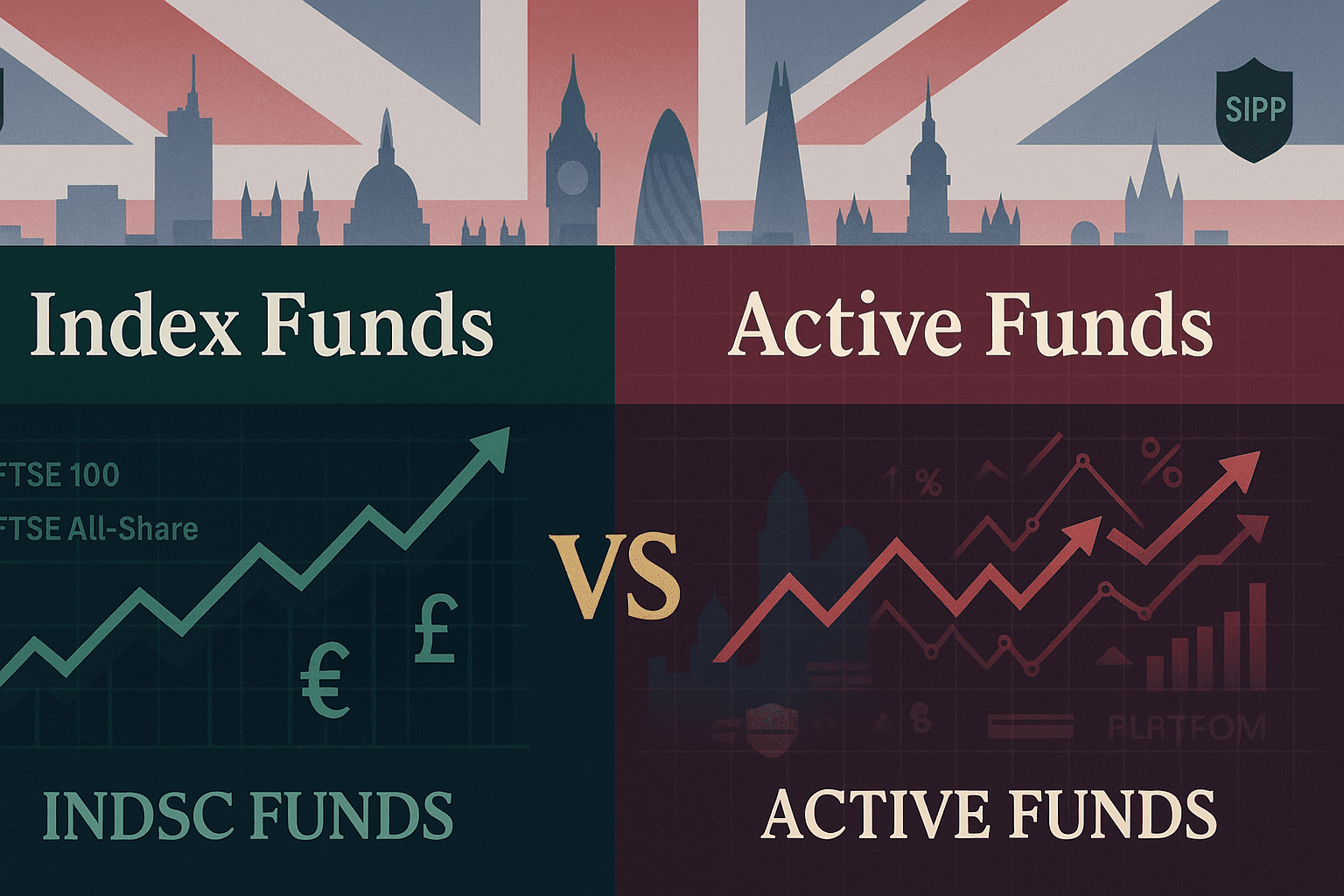
An index fund is a basket of investments that tracks a specific market index. In the US that’s typically the S&P 500 or the total US stock market. In the UK it’s the FTSE 100 or FTSE All-Share. A global tracker covers thousands of companies worldwide in one go. Think of it as buying a tiny piece of every company in the index with a single purchase.
How it works: The fund automatically buys what’s in the index. No human tries to pick winners. When Apple gains a percent, your fund nudges up. When Tesco rallies, same thing. When the broader index moves, your fund moves with it.
Actively Managed Funds: The Expert Selection Approach
An actively managed fund has a team of managers who actively pick stocks they think will beat the market. They research companies, attend meetings, and make decisions about what to buy and sell.
How it works: Fund managers get paid to outsmart the market. They try to find undervalued stocks and avoid overvalued ones. Sometimes they succeed. Usually they don’t.
The 5 Critical Differences That Matter
Cost Comparison: See Your Real Numbers
The cost difference sounds small. But over time, it’s massive. The calculators below show what fees actually cost you, in dollars and pounds.
🇺🇸 In US Dollars
💰 Index Fund vs. Mutual Fund Cost Calculator
🇬🇧 In British Pounds
💰 Index Fund vs. Active Fund Cost Calculator
Performance Reality Check: What the Data Shows
You might think expert fund managers would beat a simple index. The data says otherwise, on both sides of the Atlantic.
Here’s what S&P’s SPIVA reports show across both markets:
🇺🇸 SPIVA US: active vs. benchmark
- 1 Year: 60% of active US equity funds underperform their benchmark
- 5 Years: 80% underperform
- 15 Years: 90% underperform
🇬🇧 SPIVA UK: active vs. benchmark
- 1 Year: 72% of UK equity funds underperform their benchmark
- 5 Years: 82% underperform
- 10 Years: 82% underperform
These aren’t American stats applied to UK funds, or vice versa. S&P Dow Jones Indices measures each market separately: US active funds against US benchmarks like the S&P 500, UK active funds against UK benchmarks like the FTSE All-Share.
But What About Star Managers?
Some fund managers do beat the market. Warren Buffett famously bet $1 million that an S&P 500 index fund would outpace a basket of hedge funds over 10 years. The index fund won by a landslide. UK investors will recognise Scottish Mortgage, Fundsmith Equity, and Lindsell Train UK Equity, all with strong long-term records. The catch? You can’t reliably identify these winners in advance.
Past performance doesn’t predict future results. Many star managers eventually revert to average or below-average performance. Fund groups merge struggling funds into successful ones. Managers retire or move firms.
“The evidence that active money management adds value is pretty overwhelming in failure.” That’s John Bogle, Vanguard’s founder.
When to Choose Index Funds (Most People)
Index funds make sense for almost everyone. Here’s when they’re your best choice:
🇺🇸 If you’re investing in the US
✅ You’re Building Long-Term Wealth
If you’re investing for retirement, a house, or college funds, index funds win. The cost savings compound over decades. A 30-year-old investing $500 monthly until retirement would have roughly $100,000 more with index funds than with actively managed funds.
✅ You Want Simplicity
No research required. No wondering whether your fund manager is losing their touch. Buy a total US stock market index fund and forget it. Check back in 30 years.
✅ You Value Tax Efficiency
Index funds trade less, which means fewer capital gains distributions get kicked out to shareholders. In a taxable brokerage account, that matters: you keep more of your gains and control when taxes trigger. Inside a Roth IRA or 401(k), it matters less, but the lower fees still compound.
✅ You Don’t Want to Pay High Fees
Why pay 0.82% when 0.05% gets you better results? Over decades of compounding, that fee gap turns into a meaningful chunk of your future portfolio. Lower costs equal more money for you.
🇬🇧 If you’re investing in the UK
✅ You’re Investing in an ISA or SIPP
Tax-efficient wrappers amplify the benefit of low costs. In an ISA, all your growth is tax-free forever. Why give away 0.60% extra in fees when you could keep it?
With a £20,000 annual ISA allowance and £60,000 SIPP allowance, most UK investors can shelter all their savings tax-efficiently while using index funds to minimize costs.
✅ You’re Building Long-Term Wealth
If you’re investing for retirement or goals 10+ years away, index funds win. The cost savings compound over decades. A 30-year-old investing £500 monthly until retirement would have roughly £50,000 more with index funds than active funds.
✅ You Want UK or Global Exposure
The FTSE All-Share index represents the entire UK stock market. A global index fund gives you exposure to 7,000+ companies worldwide. Why pay someone to try beating that when they probably won’t?
✅ You Value Simplicity
No research required. No wondering if your fund manager is losing their touch. Buy a total market index fund and forget it. Check back in 30 years.
Best Platforms for Index Investing
🇺🇸 US Platforms
Vanguard
Home of the first index fund. Rock-bottom expense ratios. Trusted by tens of millions of investors.
Best For: Buy-and-hold index investors
Minimums: $1,000 for most mutual funds, $1 for ETFs
Open Vanguard AccountFidelity
Zero-fee index funds. Excellent mobile app. Best-in-class investor education.
Best For: New investors and tool-loving DIYers
Minimums: $0 for most funds
Open Fidelity AccountCharles Schwab
Modern platform. Strong research tools. Great customer service.
Best For: Tech-savvy investors who want depth
Minimums: $1 for most ETFs
Open Schwab Account🇬🇧 UK Platforms
InvestEngine
£0 platform fees for DIY portfolios. 800+ ETF selection. ISA and SIPP available.
Best For: New investors with small portfolios
Costs: £0 platform fee (0.25% for managed)
Open InvestEngine AccountTrading 212
£0 commission on 9,000+ stocks and 1,000+ ETFs. 5.1% interest on cash. Free ISA.
Best For: Active traders and index investors
Costs: £0 (earns from FX and securities lending)
Open Trading 212 AccountInteractive Investor
Flat £11.99/month fee. One free trade monthly. All account types included.
Best For: £50,000+ portfolios
Costs: £143.88 per year (all accounts)
Open ii AccountVanguard UK
Direct access to Vanguard’s low-cost funds. £4/month minimum (£48/year) or 0.15% on larger portfolios.
Best For: Vanguard fund investors with £32,000+
Costs: Greater of £4/month or 0.15% (capped at £375/year)
Open Vanguard AccountAJ Bell
24,200+ investment options. 0.25% on funds, capped at £42/year for ISA ETFs.
Best For: ETF investors wanting choice
Costs: 0.25% capped (£42 ISA, £120 SIPP)
Open AJ Bell AccountHargreaves Lansdown
UK’s largest platform. Excellent research and tools. Premium pricing.
Best For: Investors wanting full-service support
Costs: 0.45% on funds (declining tiers above £250k)
Open HL AccountWhen to Choose Actively Managed Funds (Rare Cases)
There are legitimate reasons to pick an actively managed fund. They’re just rare.
🎯 You’re Investing in UK Small-Caps
The UK small-cap category shows better active management results, with 93% outperforming in the first half of 2024. Smaller companies with less analyst coverage may reward skilled stock pickers. Consider active management here if you understand the risks.
🎯 You Need Specialist Exposure
Want to invest in UK renewable energy infrastructure? Small-cap Indian technology companies? Brazilian biotech micro-caps? Some specialized areas simply lack index fund coverage. An actively managed fund (or, in the UK, an investment trust) might be your only choice. Keep these allocations to a small part of your portfolio (10-20% maximum).
🎯 Your Employer Plan Has Low-Cost Active Options
Some employer plans offer institutional share classes of active funds with fees of 0.30% or less, similar to index fund costs. This applies to US 401(k)s with institutional fund offerings as well as UK workplace pensions with low-cost active options. If your plan offers quality active funds at near-index prices, with generous employer matching on top, that could work.
🎯 You’re a Professional Investor
If you have the knowledge to pick winning fund managers consistently (almost no one does), and you’re willing to monitor performance closely, maybe active funds make sense for a portion of your allocation. Just be honest about your expertise. Most “professional investors” still index the bulk of their own money.
How to Get Started Today
Ready to invest? Here are your step-by-step action plans.
🇺🇸 US Action Plan
Step 1: Open the Right Account
For most US investors, this priority order makes sense:
- 401(k) at work to the employer match: Free money (typically 3-6% contribution)
- Roth IRA: If eligible, gold for tax-free growth ($7,500 annual limit, plus $1,100 catch-up at 50+)
- Traditional IRA or remaining 401(k): Tax deduction now, pay taxes later ($24,500 401(k) limit, plus $8,000 catch-up at 50+)
- Taxable brokerage: For money you might need before retirement, or once tax-advantaged accounts are maxed
Open accounts at Vanguard, Fidelity, or Schwab. All three are excellent. Where you hold does change what you pay to buy certain funds, though, which Step 2 covers.
Step 2: Choose Your Index Funds
Start simple. A three-fund portfolio covers everything:
-
U.S. Total Stock Market (60-70% of portfolio)
- Vanguard: VTSAX or VTI
- Fidelity: FSKAX or ITOT
- Schwab: SWTSX or SCHB
-
International Stock Market (20-30% of portfolio)
- Vanguard: VTIAX or VXUS
- Fidelity: FTIHX or IXUS
- Schwab: SWISX or SCHF
-
U.S. Bond Market (10-20% of portfolio, more as you near retirement)
- Vanguard: VBTLX or BND
- Fidelity: FXNAX or AGG
- Schwab: SWAGX or SCHZ
Step 3: Set Up Automatic Investing
The secret to building wealth isn’t picking the perfect fund. It’s investing consistently. Set up automatic transfers from your checking account to your brokerage, IRA, or 401(k).
Start with whatever you can afford. $100 per month beats $0 per month.
Step 4: Ignore the Noise
The market will crash. Headlines will scream. Your coworker will brag about their hot stock pick. Ignore it all.
Check your accounts once per quarter. Rebalance once per year. Otherwise, live your life.
The S&P 500 has delivered approximately 6-7% real returns (after inflation) over the past century. Stay invested, keep costs low, and let compound growth work.
🇬🇧 UK Action Plan
Step 1: Choose the Right Tax Wrapper
For most people, this priority order makes sense:
- Workplace pension to employer match: Free money (typically 3-5% contribution)
- Stocks & Shares ISA: £20,000 annual allowance, completely tax-free growth
- SIPP contributions: £60,000 annual allowance with 20-45% tax relief
- General Investment Account: Only after exhausting ISA/SIPP allowances
Open accounts at InvestEngine, Trading 212, or Interactive Investor depending on your portfolio size and needs.
Step 2: Choose Your Index Funds
Start simple. A three-fund portfolio covers everything:
-
UK Total Stock Market (20-40% of portfolio)
- Vanguard FTSE UK All Share Index (0.06% OCF)
- Legal & General UK Index Trust (0.05% OCF)
- iShares Core FTSE 100 ETF (0.07% OCF)
-
Global Stock Market (50-70% of portfolio)
- Vanguard FTSE Global All Cap Index (0.23% OCF)
- Vanguard FTSE Developed World ex-UK (0.15% OCF)
- Vanguard FTSE All-World ETF (0.22% OCF)
-
UK Bond Market (10-20% of portfolio, more as you near retirement)
- Vanguard UK Government Bond Index (0.12% OCF)
- Vanguard UK Investment Grade Bond Index (0.12% OCF)
Step 3: Set Up Regular Investing
The secret to building wealth isn’t picking the perfect fund. It’s investing consistently through pound-cost averaging.
Set up a Direct Debit to your ISA or SIPP. Invest automatically each month, regardless of market conditions. This removes emotion and ensures you buy more shares when prices are low, fewer when prices are high.
Start with whatever you can afford. £100 per month beats £0 per month.
Step 4: Ignore the Noise
The FTSE 100 will crash. The Daily Mail will scream about market turmoil. Your mate will brag about their crypto gains. Ignore it all.
Check your accounts once per quarter. Rebalance once per year if your allocation has drifted more than 5%. Otherwise, live your life.
The UK stock market has delivered approximately 5-7% real returns (after inflation) over the past century. Global markets have done similarly. Stay invested, keep costs low, and let compound growth work.
The Bottom Line: Index Funds Win for Most Investors
The evidence is overwhelming. For investors on either side of the Atlantic, index funds give you:
- Lower costs (save £50,000+ over a lifetime of investing)
- Better performance (beat 82% of active UK equity funds over 10 years)
- Simplicity (no fund manager selection or performance monitoring required)
- Tax efficiency (less trading = lower CGT in taxable accounts)
- Transparency (always know exactly what you own)
- Perfect fit for ISAs and SIPPs (maximize tax-free growth)
Actively managed funds made more sense before index funds became widely available in the UK. Now they’re an expensive relic for most investors, justified only in specialized situations like small-caps or niche sectors.
🚀 Your Next Step
Don’t let analysis paralysis stop you. Pick one platform. Open one ISA. Buy one index fund. Start today.
The best time to start investing was 20 years ago. The second best time is right now.
Frequently Asked Questions
📚 Keep Learning
Want to dive deeper into smart investing strategies? Check out these guides: