
What’s changed: Updated 28 October 2026: the Budget created a Pension Tax Allowance, which answers the question this piece asked, and the article now explains how it works. Earlier, 1 October: the triple lock applies in its current form to April 2029. Full update history.
Educational, not advice. This article explains how the State Pension, the personal allowance and the new Pension Tax Allowance fit together. It is general information, not personal financial or tax advice. Savvy Investor Guide is not authorised or regulated by the Financial Conduct Authority. Nothing here tells you what to do about your own tax or pension.
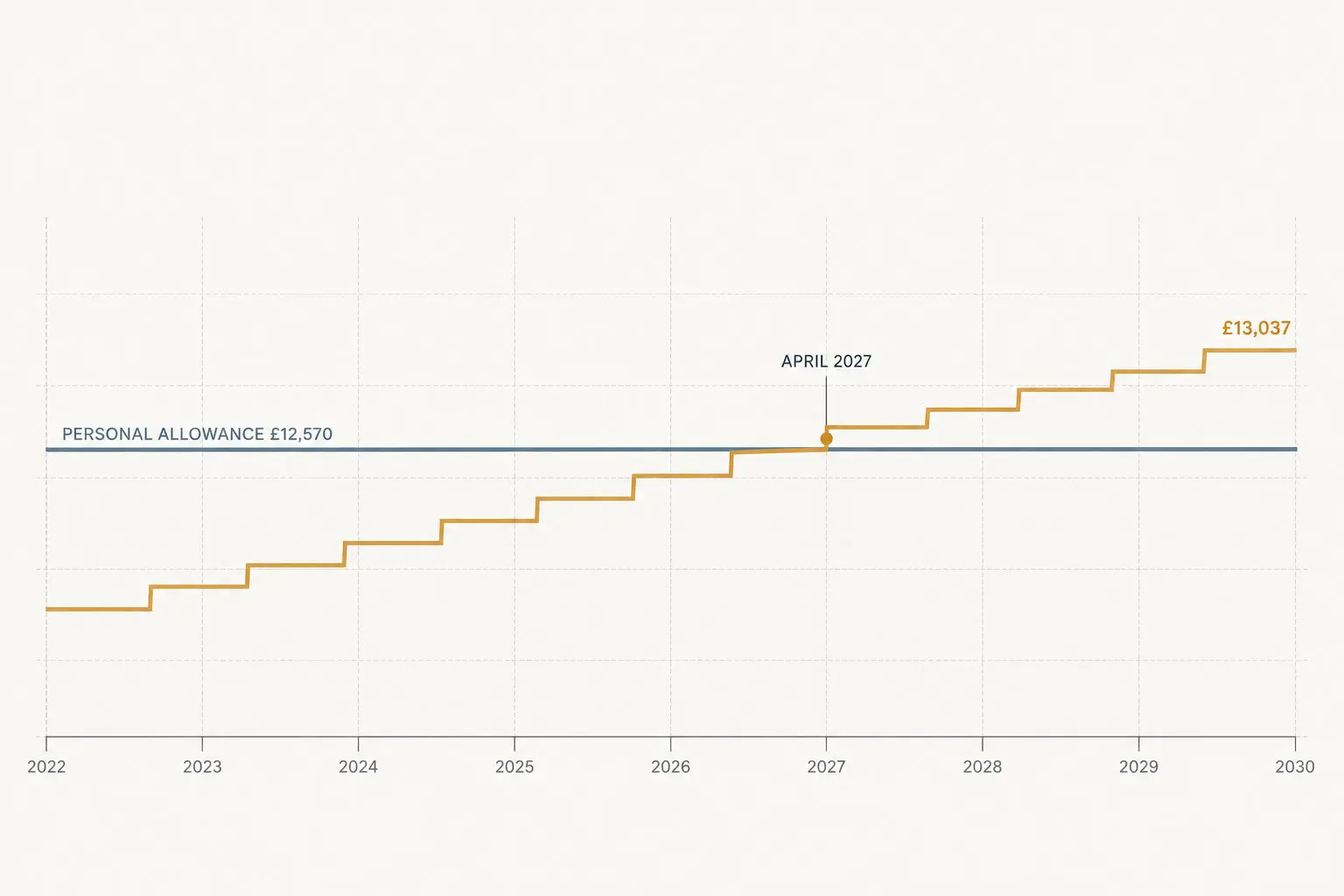
From 6 April 2027 the full new State Pension will be worth £13,036.40 over the tax year, according to HM Treasury. That is about £250.70 a week, up from £241.30, a rise of 3.9% in line with earnings growth. The personal allowance, the amount anyone can receive before income tax starts, is £12,570. It has been £12,570 since April 2021 and is not due to move until April 2031.
So for the first time the full new State Pension on its own sits above the personal allowance, by about £466.
When the crossover first became likely, much of the coverage concluded that pensioners with no other income were about to start paying income tax. The government had promised in November 2025 that they would not, but the wording was loose. The Budget on 28 October 2026 turned it into a specific rule, the Pension Tax Allowance, and the rule goes further than the original promise. Our guide to the 2026 Budget for savers and investors covers the rest of the Budget.
How the Pension Tax Allowance works
The Pension Tax Allowance is a reduction in income tax for people above State Pension age, or who reach it during the tax year. The test is total income for the year. HM Treasury’s explainer sets out the 2027-28 bands:
- Total income below £12,570: no income tax, as now. The personal allowance covers it.
- Between £12,570 and £13,037: the full Pension Tax Allowance, worth up to £94, which removes the tax.
- Between £13,037 and £13,319: a partial allowance, so some tax, but less than there would otherwise be. It falls by £1 for every £3 of income above the full new State Pension.
- £13,319 or more: no Pension Tax Allowance.
The Treasury’s own example is a pensioner whose only income is the full new State Pension of £13,036.40. Without the allowance she would owe £93.28 in income tax. With it she owes nothing.
Nobody has to claim it. HMRC applies it automatically, using the information it holds on State Pension age and income. A few other points from the explainer:
- The personal allowance itself does not change. The Pension Tax Allowance is a separate reduction in the tax bill.
- It cannot produce a refund, and it cannot be transferred to a partner.
- Scottish taxpayers get it too, calculated at the 20% basic rate rather than the Scottish starter rate.
- Income inside an ISA does not count towards total income.
- For means-tested benefits, the explainer says receiving it “may affect your entitlement”.
The Treasury expects around 500,000 pensioners to benefit in 2027-28, around 290,000 of whom will pay no tax at all because of it. It expects around 1 million to benefit by the end of this Parliament.
Who qualifies: total income, not just the State Pension
The 2025 promise was narrow. The Budget document of November 2025 said:
The government will ease the administrative burden for pensioners whose sole income is the basic or new State Pension without any increments so that they do not have to pay small amounts of tax via Simple Assessment from 2027-28 if the new or basic State Pension exceeds the Personal Allowance from that point.
That is paragraph 4.167 of Budget 2025: Strong Foundations, Secure Future. Read closely, it was a promise about paperwork, limited to people whose only income was the State Pension with nothing added. In an interview afterwards the Chancellor went further, saying eligible pensioners would not pay income tax on amounts above the personal allowance for the rest of this Parliament. The Chartered Institute of Taxation called the two statements “two quite different policy ambitions.”
The Pension Tax Allowance settles both questions. It removes the tax, not just the paperwork, and it does not depend on where the income comes from. The explainer says it applies “regardless of where your income comes from”, and lists sources that count towards total income, including:
- the new or old State Pension, including additional State Pension, protected payments and extra payments from deferring;
- an occupational or private pension;
- income from part-time work or self-employment;
- rental income, and interest on savings and dividends outside an ISA.
So someone with a part State Pension and a small workplace pension qualifies, provided the total stays within the limits. The same goes for someone who deferred their State Pension, or who has no State Pension at all but is over State Pension age. The total is what decides it. Anyone whose income from all sources is £13,319 or more in 2027-28 gets nothing from the allowance and pays tax in the usual way.
Most pensioners already pay tax on the State Pension
For most pensioners none of this changes anything, because their income is well above the allowance’s upper limit.
If you have a workplace or personal pension alongside your State Pension, you are almost certainly paying tax on the State Pension already, and have been for years. It is easy not to notice, because of how the tax is collected.
The Department for Work and Pensions does not operate PAYE. The State Pension is paid gross, with nothing deducted. HMRC deals with the tax by adjusting the tax code on your other pension: it reduces the tax-free amount set against that pension by roughly the value of your State Pension, so more tax comes out of the pension that does run PAYE. This is called coding out, and it is why the State Pension feels untaxed when it is not. The tax is real. It is taken somewhere else.
Simple Assessment is the fallback for people with no PAYE income to code the tax against. HMRC sends a calculation, formally a PA302, and asks for payment directly. gov.uk describes it as what happens “if you did not pay enough tax and they could not collect it through your tax code,” and stresses it is not a Self Assessment return.
That is the problem the Pension Tax Allowance was written to avoid: people on low incomes receiving a tax bill for a small sum. The explainer says that where the allowance removes all the tax due, no Simple Assessment is issued for that year. Where some tax remains and cannot be collected another way, HMRC may still send one, showing the amount after the reduction.
The personal allowance freeze runs to 2031, not 2028
A lot of what is published online on this point is out of date.
The personal allowance was frozen at £12,570 from April 2021, originally for four years. The Autumn Statement in 2022 extended the freeze by two years, to April 2028, and a great deal of commentary still stops there. The Autumn Budget in November 2025 extended it again, by a further three years, to April 2031.
That matters because the gap does not close on its own. The State Pension rises every year under the triple lock. That rule applies unchanged to the April 2027, 2028 and 2029 increases, and the government plans to adjust it from April 2030, as our piece on the triple lock after 2030 explains. The allowance stays where it is for another five years, so the amount by which the State Pension exceeds it grows each year. The Pension Tax Allowance keeps pace for now: for 2028-29 and 2029-30 its limit rises in line with the full new State Pension.
What is still open
The Pension Tax Allowance is set for three tax years, 2027-28 to 2029-30. The explainer says the government “will keep the Pension Tax Allowance under review and will consider any arrangements beyond April 2030 in the usual way.” What happens after April 2030, when the personal allowance is still frozen and the adjusted triple lock begins, has not been decided.
It is also not a permanent exemption. In the explainer’s words, “The State Pension remains taxable income.”
The short version
The full new State Pension will be £13,036.40 a year from April 2027, about £466 above a personal allowance that is frozen until 2031.
If you are over State Pension age and your total income from all sources is no more than that, the new Pension Tax Allowance removes the tax, and HMRC applies it without being asked. Between £13,037 and £13,319 it reduces the tax. Above that, nothing changes.
If you have a larger pension or other income, none of this is new. Tax on your State Pension has been collected all along through the code on your other pension, and April 2027 changes nothing about that.
Pension Plain and Savvy Investor Guide explain the rules. Neither gives financial advice, and nothing here is a recommendation about your own circumstances.
Sources
- HM Treasury, Pension Tax Allowance Explainer, 28 October 2026.
- HM Treasury, Budget 2026, 28 October 2026.
- ONS, Average weekly earnings in Great Britain, released 15 September 2026. Total pay 3.9%, regular pay 3.5%, May to July 2026.
- ONS, Consumer price inflation, UK: September 2026, released 21 October 2026. CPI 3.5%.
- gov.uk, The new State Pension: “The full rate of new State Pension is £241.30 a week.”
- gov.uk, Income Tax rates and allowances: personal allowance £12,570 for 2026/27.
- House of Commons Library, State Pension triple lock: “a government commitment to uprate the basic and new State Pension every year by the highest of earnings growth, inflation, or 2.5%.”
- HM Treasury, Budget 2025: Strong Foundations, Secure Future, November 2025, paragraph 4.167.
- Chartered Institute of Taxation, Tax Adviser, “Budget 2025: state pension only income and simple assessment”, 5 January 2026.
- gov.uk, Simple Assessment and Understand your Simple Assessment tax bill.
Footnote on the earnings measure. The triple lock’s earnings leg uses ONS average weekly earnings on the total pay measure, which includes bonuses, for the three months May to July. That is why this piece uses 3.9% rather than the 3.5% regular-pay figure from the same release. The Commons Library summary states the three legs but not the measure, so this is derived rather than quoted: the last three upratings were 4.8%, 4.1% and 8.5%, matching total pay for May to July in each preceding year exactly. The weekly figure of about £250.70 is £13,036.40 divided by 52; the Treasury gives only the annual value.
Update history: 28 October and 1 October 2026
Update, 28 October 2026: The Budget on 28 October created the Pension Tax Allowance, and the body now explains it in place of the questions it left open. Three things in the earlier version no longer hold and have been removed: that the promise covered only pensioners whose sole income was the State Pension without increments, that anyone with an occupational pension was outside it, and that the April 2027 figure was not yet fixed. The September CPI figure (3.5%) came in below earnings growth (3.9%), and HM Treasury now gives the full new State Pension as £13,036.40 for 2027-28. The earlier “What is still not known” section, which said no official count of those affected existed, is replaced by the Treasury’s estimates.
Update, 1 October 2026: On 29 September the Prime Minister said the triple lock will stay unchanged for this Parliament and be adjusted from April 2030. The sentence on the State Pension rising every year now says so and links to our article on the change. The April 2027 figures in this piece are not affected.