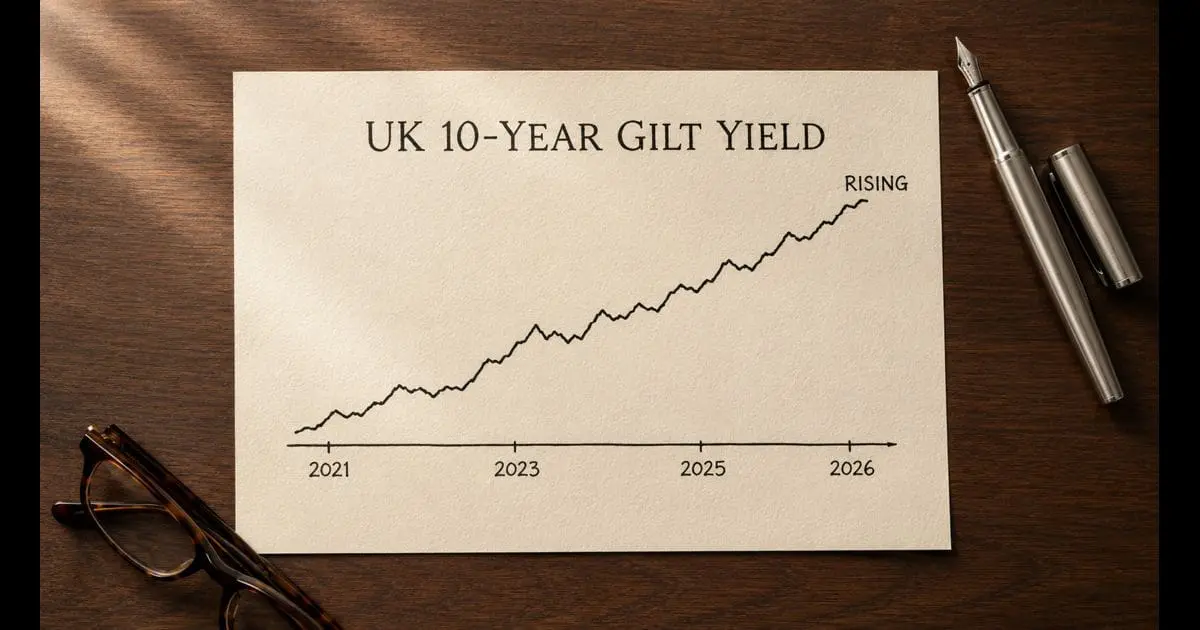

Update, 18 September 2026. The Bank of England held Bank Rate at 3.75 percent on 17 September, by six votes to three, with three members preferring a rise to 4 percent. It said CPI inflation “increased to 3.1% in August and is likely to rise further over coming quarters”. Source: Bank of England, 17 September 2026.
For gilts, the more important announcement came alongside it. The Bank will hold £120 billion of its longest-dated gilts to maturity rather than sell them, keep £222 billion maturing before 2035 to maturity, and sell the rest at about £20 billion a year, finishing around 2034. Its gilt sale auctions are paused while it reviews selling gilts to the Government instead. Less long-dated supply coming back to the market is the part yields respond to, and reports put the 10-year down about 0.09 points on the day. Source: Bank of England market notice, 17 September 2026.
Earlier updates on this article (May to August 2026)
Update, 20 August 2026. July CPI, published by the ONS on 19 August, rose to 2.9 percent from 2.6 percent in June. CPIH rose to 3.1 percent from 2.8 percent, and on the month CPI was up 0.3 percent. That reverses the easing the 22 July note described.
The number that matters most here is the one that did not move. Core CPI, which strips out energy, food, alcohol and tobacco, was 2.6 percent, unchanged from June. The rise therefore sits almost entirely in the volatile components core excludes, rather than in the domestically generated inflation the Bank of England watches hardest. A headline jump with a flat core is a different signal from a broad-based one, and the gilt market read it that way.
Trading Economics quotes the 10-year gilt at 5.04 percent on 20 August, and notes the yield has edged up 0.01 points over the past month while standing 0.31 points higher than a year ago. The 10-year has spent a month sitting close to 5 percent rather than trending, which is consistent with the “read the range, not the trend” framing in the 31 July note below. The 30-year is not quoted here, per the standing note.
The next Monetary Policy Committee decision is 17 September 2026, with Bank Rate at 3.75 percent after the 6 to 3 hold on 30 July. A headline rate rising while core holds flat gives the Committee’s hawks material without settling the argument, so nothing here changes the practical read for borrowers and savers set out below.
Update, 31 July 2026. The Bank of England held Bank Rate at 3.75% on Thursday 30 July, and the vote was harder than the market had priced. The Monetary Policy Summary and Minutes put it like this: “Six members (Andrew Bailey, Sarah Breeden, Swati Dhingra, Clare Lombardelli, Dave Ramsden and Alan Taylor) voted in favour of the proposition. Three members (Megan Greene, Catherine L Mann and Huw Pill) voted against the proposition, preferring to increase Bank Rate by 0.25 percentage points, to 4%.” Economists polled before the meeting had expected two dissenters, not three. Mann was the addition.
One note on how firm that figure is, because the convention differs from the American one. The Bank publishes both sides of the vote and names every member on each side, so a 6 to 3 split is the Bank’s own count rather than an inference. The Federal Reserve names only the members who vote against, so any total quoted for an FOMC vote has been worked out from its published membership instead of printed by the Fed.
On the reasoning, the Committee said that “the risks to the inflation outlook are tilted to the upside relative to the central projection in the July Monetary Policy Report”, and named the source of that risk directly: “The conflict in the Middle East, and its impact on energy prices and the UK economy, remained the dominant source of uncertainty for the inflation outlook.”
The gilt market moved the opposite way from the vote. The 10-year had climbed back above 5 percent during 29 and 30 July, reaching about 5.06 percent, and has since eased below the line again: Trading Economics quotes 4.98 percent on 31 July, and Investing.com shows 4.9869 at Thursday’s close. That is the third change of direction in five days, so the accurate description is a market oscillating either side of 5 percent rather than one that has broken in either direction. Read the range, not the trend. The mortgage, savings and ISA mechanics set out below are unchanged.
Update, 29 July 2026. The pause described in the note below has broken. On the evening of 28 July Iran launched a ballistic missile barrage at American forces in the Middle East. US Central Command said all of the missiles were intercepted, and the Associated Press reported that the events “shattered a brief pause in fighting”. The United States and Saudi Arabia then struck sites in Iraq used by Tehran-backed militias, with the Saudi defence ministry saying the kingdom “does not seek escalation but will respond to any aggression it faces”.
Oil reversed immediately. Brent rose about 4 percent overnight, unwinding part of a steep three-session fall. The price feeds disagree on the exact level this morning by more than two dollars, so the size of the move is the more reliable figure, not any single quoted price.
For gilts the important point is about cause rather than level. The 10-year gilt has not moved yet. It closed between roughly 4.95 and 4.98 percent, still below 5 percent, and the UK market had not opened when this note was written. So the statement below, that the run above 5 percent has ended, still describes where the market closed. What has changed is the reason it ended. That fall was attributed to a de-escalation which has now reversed, and the caution set out on 27 July, that a reciprocal pause is not a settlement because either side can resume, is what happened four days later. Whether the level follows the cause is the thing to watch when trading opens.
Update, 27 July 2026. The run above 5 percent has ended. The 10-year gilt slipped back below the line on Monday morning, trading around 4.98 percent after closing at about 5.03 percent on Friday. It had held above 5 percent since late on Monday 20 July, which was its longest stretch above that level since July 2008.
What broke it was the Middle East, running in the opposite direction from the last six weeks. The United States and Iran have both paused strikes, with Tehran saying it stopped its retaliatory operations after Washington did, and the pause held through the weekend into a third day. Brent crude has fallen to about $91.70, down more than 5 percent on the day.
Two cautions before reading too much into it. First, the level has come down but not far. Slipping to 4.98 percent is a few basis points below a round number, not a new regime, and Brent is still around a quarter higher than it was a month ago. Second, a reciprocal pause is not a settlement and either side can resume. What it does mean for the mechanics set out below is that the funding-cost pressure behind recent mortgage and savings pricing has stopped building for now. Mortgage lenders were still repricing upward this week, which is not a contradiction: they price off the swap curve with a lag, and they raise faster than they cut.
Update, 22 July 2026. June CPI came in at 2.6 percent this morning, down from 2.8 percent in May and the lowest since March 2025, and the gilt market barely moved. The 10-year gilt sat around 5.03 to 5.04 percent after the release, having closed on 21 July at about 5.06 percent, its highest since 20 May; the 30-year closed at about 5.77 percent, a fresh two-month high. Two forces are outweighing the better inflation news: oil, with Brent trading near $94 to $95 on 22 July as the Middle East conflict escalated further, and the fiscal picture, as markets weigh the new government’s talk of flexibility against Chancellor John Healey’s stated commitment to fiscal discipline. One warning for the next print: the July energy price cap rise means July inflation could move back above 3 percent, so one soft month does not make a trend. The mortgage, savings and ISA mechanics below are unchanged. The next Bank of England decision is Thursday 30 July.
Update, 17 July 2026. The 10-year gilt has swung both ways this month. It pushed back above 5 percent in mid-July as Middle East conflict lifted oil and revived inflation worries, then eased to about 4.96 percent after reports that the incoming prime minister would name Shabana Mahmood as chancellor, a pick markets read as continuity rather than a shift to looser policy (sterling rose to about 1.35 dollars on the same news). Treat that as attributed market reaction, not a political verdict, and note the appointment was still unconfirmed pending the formal cabinet on 20 July. On the data, UK GDP grew 0.1 percent in May (0.7 percent across the three months to May), a sixth straight quarter of growth, which does little on its own to move the rate picture. The mortgage, savings and ISA mechanics below are unchanged; the gilt market is being pulled between oil-driven inflation risk and hopes of fiscal continuity.
Update, 10 July 2026. The 10-year gilt reached about 4.95 percent on 9 July, its highest since 10 June, as the same oil-price and fiscal pressures noted above continued to feed through. Market-implied pricing for a Bank of England rate hike has firmed to roughly 76 percent by year-end, and above 50 percent for the November meeting.
Update, 2 July 2026. Gilt yields have eased since the early-June levels below. The 10-year gilt is around 4.8% and the 30-year around 5.5% as of early July 2026 (Trading Economics, 2 July), with the 10-year near two-month lows after softer UK data and the Bank of England’s 18 June hold at 3.75% (next decision 30 July). The mortgage, savings and ISA mechanics explained below are unchanged; the direction since early June has been gently lower.
Update, 3 June 2026. The Iran-cyclical leg of the May story has reversed sharply. Talks between Washington and Tehran were formally suspended on 1 June over Israeli strikes in Lebanon, and on 2-3 June the United States and Iran exchanged strikes: US Central Command struck an Iranian military ground control station on Qeshm Island in the Strait of Hormuz, in response to Iranian strikes on Kuwait and Bahrain that failed to hit their targets. Iran’s Revolutionary Guard said it had targeted the headquarters of the US Navy’s 5th Fleet in Bahrain. Brent crude opened Wednesday 3 June near $97 per barrel, a third consecutive session of gains, up from Friday’s $92.05 close. The 10-year gilt sits at roughly 4.85% at the start of June, having walked back from late-May lows. Swap rates have moved up overnight in response to the Hormuz escalation, the same transmission mechanic the “From gilt yield to mortgage swap rate” section below sets out. Andrew Bailey, speaking on 29 May, said the Bank “is in no rush to raise interest rates while the outcome of the Iran war remains uncertain”, which is a dovish framing on its face, but the practical effect for borrowers is the same as a hawkish one: rate cuts are not being signalled in the near term. Lenders had continued to cut fixed mortgage rates through late May after the earlier Iran-driven hike wave from February to April eased; that cut cycle may now slow or partially reverse if swap rates stay elevated. Practical read for borrowers: the late-May “lock it” framing still holds, and the window for cuts to deepen further looks narrower this week than it did last week. The companion mortgage piece has been updated in lockstep. Sources: India TV, 3 June 2026; Euronews, 3 June 2026; Trading Economics, Brent crude live tick.
Update, 30 May 2026. The structural US hawkish anchor has now landed, independent of the Iran cyclical story above. April PCE inflation printed on 28 May at 3.8% headline (up from 3.5% in March) and 3.3% core (up from 3.2%), both the highest in years and both well above the Federal Reserve’s 2% target. Kevin Warsh, who took the Fed Chair on 15 May, said publicly the same week that “cutting interest rates is not possible with the current state of inflation and the ongoing war” and that “addressing the current inflation may necessitate raising interest rates.” This is the first explicit hike-bias signal from the new Chair, and it confirms the “higher for longer under Warsh” framing the 27 May update referenced from Bloomberg’s 25 May piece. For UK gilt watchers, the practical implication is that even if the Iran exchange de-escalates mid-June, PCE at 3.8% headline plus a new Chair publicly leaning hawkish keep US yields elevated. The transatlantic-split mechanic in the 23 May Waller update below holds in either scenario. Sources: RIS Media, 29 May 2026; Fortune, 30 May 2026; Investor Ideas, 28 May 2026.
Earlier updates
- 27 May 2026: The 10-year gilt closed at 4.86% on 26 May, its lowest since 21 April and the sharpest weekly fall since 2024, on weak UK macro and Middle East de-escalation; the 18 June MPC stayed live while the US side diverged (30-year Treasury near 5.08%, a higher-for-longer signal under the new Fed Chair).
- 23 May 2026: Fed Governor Christopher Waller’s hawkish 22 May speech, signalling the next move could as easily be a hike as a cut and backing removal of the easing bias, put the US on the same lean-against-cuts path as the UK.
- 22 May 2026: The 10-year gilt eased to about 4.95% (from 5.07% on 21 May), but JP Morgan’s single-hike call for 18 June stayed live and the swap curve kept pricing two-way risk.
- 20 May 2026: ONS April CPI came in at 2.8%, with services inflation dropping sharply from 4.5% to 3.2%, a material undershoot; the 10-year then sat around 5.07 to 5.10%.
Update — 21 May 2026 (post-TSC). At the Treasury Select Committee hearing on the afternoon of 20 May, Bailey explicitly declined to give a “cast iron assurance” there would not be a rate increase, even with CPI at 2.8%. His framing: rising market rates since the Iran conflict have given the Bank “more time to assess economic ramifications”, and higher mortgage costs are “a prime example of how investors have adjusted their positions.” The MPC is split on the path. Swati Dhingra suggested rate hikes can be avoided if the second-round effects from the energy shock are moderate; Catherine Mann warned that persistent high inflation into late 2026 could embed in 2027 wage deals and produce a more hawkish posture next year. Markets repriced after the hearing: JP Morgan now predicts one hike on 18 June; Goldman Sachs and Oxford Economics expect a hold. The full-year 2026 swap curve prices in 2 to 3 hikes, not the 2 to 3 cuts that were dominant pricing in March. Practical read for borrowers and savers: the assumption that “CPI is down so the next move must be a cut” is no longer reliable; lenders are pricing two-way risk, which is why some products are being cut and others hiked in the same week.
NOT regulated financial advice. Savvy Investor Guide is not regulated by the Financial Conduct Authority and we are not financial advisers. Everything on this site is general financial information and education. Nothing here is personal financial advice. Before making any financial decision, consider speaking to a qualified independent financial adviser.
What this article covers: what UK gilt yields are, what drove the spike in May 2026, the political backdrop, and what the move means practically for mortgages, savings accounts, ISAs, and pension drawdown.
What it does not cover: whether you should buy or sell any specific product. This is explanation, not advice.
Between 11 and 15 May 2026, the yield on 10-year UK government bonds climbed to 5.14%, with a 5.165% intraday high on 15 May — the highest level since 2008, when the country was heading into the financial crisis. The 30-year gilt yield reached 5.86%, a level not seen since 1998. Across the week, the 10-year added roughly 25 basis points, the largest single-week rise since the Iran war broke out. The move accelerated on 14 and 15 May after Health Secretary Wes Streeting resigned from cabinet calling for a Labour leadership contest, and Manchester Mayor Andy Burnham announced plans to stand in the Makerfield by-election. Implied breakeven inflation, derived from the gap between conventional and index-linked gilts, sat at 3.42%, well above the Bank of England’s 2% target. Current yields are also well above the Office for Budget Responsibility’s March 2026 baseline assumptions of 4.5% on the 10-year and 5.3% on the 30-year, which puts the fiscal-headroom calculation under pressure regardless of how the leadership question resolves.
For most people, gilt yields register somewhere between obscure and irrelevant. They are not. The rate the UK government pays to borrow money for 10 or 30 years feeds directly into the rate your bank charges you to borrow for five, and the rate it offers you to save for two. If you have a mortgage coming up for renewal, a cash ISA to place, a fixed-rate savings account to open, or a pension pot to convert to income, the gilt market is the upstream force shaping all of those numbers right now.
In short
- UK 10-year gilt yields reached 5.14% on 15 May 2026, the highest since 2008. The 30-year hit 5.86%, the highest since 1998.
- The trigger was a sequence of political signals: 70+ Labour MPs called for Prime Minister Starmer to resign after heavy local election losses on 1 May; Health Secretary Wes Streeting resigned from cabinet on 14 May calling for a leadership contest; Manchester Mayor Andy Burnham announced plans to stand in the Makerfield by-election on 15 May.
- Current yields are well above the OBR’s March 2026 baseline (4.5% on 10-year, 5.3% on 30-year). The gap puts the fiscal-headroom calculation under pressure regardless of who leads the next government.
- Pantheon Macroeconomics estimated that a change of PM could add around 45 basis points to 10-year borrowing costs. Debt-servicing costs could run approximately £18bn above Budget projections.
- The Bank of England held its base rate at 3.75% on 30 April (8-1 vote). The next MPC meeting is 18 June.
- High gilt yields mean: mortgage swap rates stay elevated, savings rates hold up, annuity rates improve. They do not mean the BoE base rate is about to rise.
- A sister article covers the mortgage-specific picture in more depth.
What gilt yields are
A gilt is a UK government bond. When the government wants to borrow money, it issues gilts. Each gilt has a face value (say £1,000), a coupon (a fixed annual interest payment, say £40), and a maturity date (the date the £1,000 is paid back).
The yield is the implied annual return to a buyer who purchases that gilt at today’s market price. It is not the same as the coupon. If the price of the gilt falls in the secondary market, the fixed coupon payment represents a higher return on the lower price paid, so the yield rises. If the price rises, the yield falls. Bond prices and yields always move in opposite directions.
When gilt yields rise sharply, it means buyers are demanding a higher return to hold UK government debt. That can happen because inflation expectations have risen (buyers want compensation for the purchasing power they will lose), because political or fiscal risk has increased (buyers want a premium for uncertainty), or both.
The 10-year gilt yield is the one that matters most for most financial products. It represents the cost of borrowing for a decade, the benchmark that banks, mortgage lenders, and pension providers use to price medium-to-long-term products. The 30-year yield matters more for pension liabilities and annuity pricing.
What just happened: the May 2026 gilt move
On 11 May 2026, UK gilt yields began rising sharply. By 13 May, the 10-year had crossed 5.1% and the 30-year had briefly touched 5.81%. By 15 May, after Streeting’s cabinet resignation and Burnham’s by-election announcement, the moves had extended: 10-year to 5.14%, 30-year to 5.86%. Both represent multi-decade highs.
Two forces were at work simultaneously. The first was the ongoing structural pressure from inflation staying above target. The implied breakeven inflation rate — the gap between conventional gilt yields and index-linked gilt yields, which shows what the market expects inflation to average over the long term — sat at 3.42%, more than 1.4 percentage points above the Bank of England’s 2% target. When breakeven inflation is that elevated, buyers of conventional gilts demand a higher yield to compensate.
The second force was political. On 1 May 2026, local election results came in heavily against the Labour government, and by 11 May more than 70 Labour MPs had publicly called for Prime Minister Keir Starmer to resign. The markets interpreted this as a signal of political instability, with the risk that a change in leadership could shift fiscal policy at a time when the UK’s debt trajectory was already under pressure.
Pantheon Macroeconomics estimated that a change of Prime Minister could add approximately 45 basis points to 10-year gilt yields. In budget terms, the firm estimated that borrowing costs could run around £18bn higher than the projections set out in the October 2025 Autumn Budget. That figure reflects how sensitive UK debt servicing has become to marginal moves in long-term rates, given the volume of debt outstanding.
The Bank of England held its base rate at 3.75% at its April 2026 Monetary Policy Committee meeting, voting 8-1 to hold. The one dissenter voted for a cut. The next MPC decision is on 18 June 2026. The gilt market move does not directly determine the base rate, which is set by the MPC based on inflation and growth data, but elevated long-term yields tighten financial conditions independently of the base rate.
Sources: CNBC, 12 May 2026; Bloomberg, 12 May 2026; Bank of England MPC, April 2026.
The political backdrop
On 1 May 2026, local council elections in England produced significant losses for the Labour Party. In the days that followed, the volume of public dissent within the parliamentary party grew. By 11 to 13 May, more than 70 Labour MPs had publicly called for Prime Minister Keir Starmer to stand down. On 14 May, Health Secretary Wes Streeting resigned from cabinet, stating publicly that Starmer would not lead the party into the next general election and calling for a leadership contest. On 14 May, HMRC also concluded its investigation into Deputy Prime Minister Angela Rayner’s stamp-duty affairs, finding she had exercised “reasonable care” and clearing her of any deliberate wrongdoing. Rayner declined to rule out a leadership bid. On 15 May, Manchester Mayor Andy Burnham announced plans to stand in the Makerfield by-election, opening a possible path to Westminster and a leadership bid. Both developments intensified the political uncertainty without resolving it.
The gilt market’s response to this was not about which party might replace him, or whether the calls would succeed. Markets do not generally care about the politics in the way commentators do. What they care about is uncertainty and the risk to fiscal policy. A change of Prime Minister would mean a leadership contest, a potential change in fiscal strategy, and a period where spending commitments, tax plans, and borrowing projections are unclear. That uncertainty is a risk premium, and gilt buyers demanded a higher yield to compensate for it.
The same mechanism played out in September 2022 when the Truss government announced unfunded tax cuts. The subsequent gilt sell-off became the LDI crisis: markets recalibrating the risk premium on UK government debt in response to perceived fiscal instability. May 2026’s move was smaller and did not trigger a systemic crisis, but it reflected the same underlying logic.
The key point for this article is mechanical: political uncertainty raised gilt yields, and higher gilt yields have real consequences for the financial products ordinary households use. The rest of this article works through those consequences product by product.
From gilt yield to mortgage swap rate: the mechanic
There is a chain of transmission between the 10-year gilt yield and the interest rate on a five-year fixed mortgage. Understanding it is useful because it explains why mortgage rates do not simply follow the Bank of England base rate up and down.
Step one: the gilt yield sets the baseline. The 10-year gilt yield is the risk-free rate for UK sterling borrowing over a decade. It is the floor. Any lender extending credit has to earn more than this to justify the risk.
Step two: the swap market translates gilt yields into fixed-rate funding costs. Banks that want to offer fixed-rate mortgages need to fund them at a fixed rate themselves. They do this via interest rate swaps, where they exchange a floating-rate liability (their deposit base, which reprices frequently) for a fixed-rate one that matches the term of the mortgage product they want to offer. The price of a five-year swap, the five-year swap rate, is closely correlated with the five-year gilt yield, which itself moves broadly in line with the 10-year.
Step three: the lender adds a margin. The swap rate is the base. The lender then adds a margin for credit risk, operating costs, and profit. The final mortgage rate is swap rate plus margin.
This means that when gilt yields rise, swap rates rise, and fixed mortgage rates rise, even if the BoE base rate has not moved. It also means that when gilt yields fall, mortgage rates can fall faster than the base rate alone would suggest. In May 2026, with gilt yields at 17-year highs, the swap market was pricing longer-term fixed rates higher, maintaining upward pressure on the fixed mortgage deals on offer.
Source: ShareScope market commentary, 13 May 2026.
What this means for mortgages
The short version: elevated gilt yields keep fixed mortgage rates elevated. A base rate of 3.75% would, in normal conditions, suggest five-year fixes closer to 4% than 5%. But five-year swap rates are pricing in long-term expectations that include sustained inflation and political risk premiums, which is why the best five-year fixes in May 2026 were sitting well above 4%.
For borrowers coming off fixed deals in 2026, the question is whether to fix now, take a tracker, or wait. There is no universally right answer. It depends on your loan size, your risk appetite for payment volatility, and your view on the rate path.
The mortgage-specific picture, covering product types, lender behaviour, and what to do if your fix ends in 2026, is covered in the sister article: UK mortgage rates in context: May 2026.
One refinement on direction of travel. The data published by Moneyfacts on 8 May showed the average two-year fixed rate flatlining at 5.78% and the five-year edging up from 5.68% to 5.70%. Adam French at Moneyfacts characterised it as the recent momentum behind falling rates “stalling as lenders become more cautious amid ongoing volatility in funding costs.” The week ending 15 May did see further lender cuts (Nationwide trimmed selected products by up to 36bps, NatWest by up to 21bps, and Santander dropped a first-time-buyer product to 3.92% at the lowest loan-to-value tiers), but these were competitive-margin moves on specific products rather than a wholesale repricing of the headline averages. With the 10-year gilt now at 5.165% and the swap market repricing in response, the next round of headline-average data is more likely to drift up than down.
What this means for savers
For savers, high gilt yields are broadly good news, at least in the short term. Banks and building societies fund their savings products partly by comparing what they can earn investing in gilts or lending in the swap market against what they need to pay depositors to attract funds. When gilt yields are high, the opportunity cost of sitting in low-rate deposits rises, and competitive pressure pushes savings rates up.
In practice, the best easy-access savings rates in May 2026 were sitting in the 4.5% to 5% range at challenger banks and building societies, significantly ahead of where they were before rates began rising in 2022. NS&I’s Premium Bonds effective rate remained at 4% (the prize-fund rate), but fixed-term accounts from challengers were offering above 5% for one and two-year terms.
The caveat is that savings rates lag gilt yields both on the way up and on the way down. If gilt yields were to fall sharply, for example because political uncertainty resolved and inflation dropped back toward 2%, savings rates would follow with a delay of typically two to six months. The window of genuinely high savings rates is open now, but it will not stay open indefinitely.
If you have a large cash sum sitting in a current account or a legacy easy-access account paying under 3%, the gap between that and what is currently on offer is substantial. Switching is straightforward through comparison tools and takes minutes for most regulated UK accounts.
What this means for ISA decisions
Cash ISA rates have moved in step with the broader savings market. In May 2026, the best cash ISA rates, both easy-access and fixed-term, were competitive with their non-ISA equivalents, which was not always true in the low-rate era. Given the Personal Savings Allowance (£500 for higher-rate taxpayers, £1,000 for basic-rate taxpayers), higher earners saving larger sums now have a genuine reason to prefer the ISA wrapper to maximise tax-free interest.
From 2027, the annual ISA allowance drops from £20,000 to £12,000 per year for cash ISAs. The rules for stocks and shares ISAs differ; check current HMRC guidance as this was still subject to consultation at the time of writing. If you have unused ISA allowance in 2026/27, using it before April 2027 locks in the higher contribution limit.
On the fixed versus easy-access question: a one or two-year fixed cash ISA at 5%+ gives you certainty over that return. An easy-access ISA gives you flexibility if rates move. If you believe gilt yields will fall materially over the next 12 months as political risk fades and inflation moderates, locking in a one-year fix while rates are high can make sense. If you think rates will stay elevated, easy-access gives you the option to roll into a better deal later.
Source: Moneyfacts, cash ISA allowance.
What this means for pension drawdown and annuities
For people approaching retirement or already in drawdown, the gilt yield environment is one of the most significant factors affecting their options, particularly if they are weighing up an annuity.
Annuities are priced directly off gilt yields, particularly long-dated gilts. When you buy an annuity, the insurer invests your lump sum in long-dated bonds (mostly gilts) and uses the yield from those bonds to fund the income they pay you for life. When long-term gilt yields are high, the insurer can afford to offer you a higher income for the same lump sum.
In 2020 and 2021, when the 10-year gilt yield was around 0.3%, annuity rates were at generational lows: roughly £4,500 to £5,000 per year for a £100,000 purchase for a 65-year-old. By May 2026, with the 30-year gilt around 5.86%, equivalent annuity quotes had improved to around £7,000 to £7,500 per year for the same sum. That is a material difference in lifetime income from the same pot.
This does not mean everyone in drawdown should rush to convert to an annuity. Drawdown retains flexibility and growth potential; annuities provide certainty and longevity protection. But for someone who wants guaranteed income, the high gilt yield environment of 2025 to 2026 is the best annuity-buying window in over a decade. If gilt yields were to fall back toward 3%, annuity rates would follow.
For those already in drawdown investing in a diversified portfolio, high gilt yields mean the bond allocation is under capital pressure (when yields rise, existing bond prices fall), but new purchases or rollovers into bonds are at better rates than two or three years ago.
What an informed retail investor can take from the macro picture
This section is not advice. It is a framing of the considerations a financially literate person might hold in mind.
The gilt yield spike is multi-causal. It is not purely political. Breakeven inflation at 3.42% means the market believes UK inflation will average significantly above 2% for years. That structural inflation backdrop limits how quickly the BoE can cut rates, which in turn limits how quickly gilt yields can fall. Political risk is a component, but it sits on top of an already elevated interest rate environment.
The base rate and gilt yields are not the same thing. A base rate cut from 3.75% to 3.5% in June does not mean mortgage rates will fall by 25bps. If gilt yields stay elevated, fixed mortgage rates will stay elevated regardless of what the MPC does to the overnight rate. Trackers follow the base rate; fixed products follow the swap market, which follows gilts.
High rates have distributional effects. They are good for savers, good for new annuity buyers, bad for people with large variable-rate debts, and ambiguous for homeowners depending on whether they are net borrowers or net savers over their remaining mortgage term.
Gilt yields do not stay at extremes forever. The current level reflects a specific combination of factors: sticky inflation, fiscal risk from government debt levels, and political uncertainty. Any one of those easing materially could bring yields lower. What the timing looks like is genuinely uncertain.
Direct gilt investment is an option some investors consider. You can buy UK gilts directly through a stockbroker or via the DMO’s retail gilt programme. At current yields, a 10-year gilt bought today locks in a roughly 5.14% annual return in nominal terms if held to maturity. The FAQ below covers this in more detail.
FAQ
Should I fix my mortgage now or wait for rates to fall?
There is no single right answer. Fixing now gives you certainty: you know exactly what you will pay for the next two, three, or five years. Waiting risks rates staying high or rising further, but preserves the option to benefit if they fall. The main factors to weigh are: how large is the gap between current fixed rates and your existing deal, how sensitive your budget is to a payment rise, and how confident you are about the rate outlook. A mortgage broker can model the scenarios for your specific loan. This article does not make the decision for you.
Are savings rates going to rise from here?
Savings rates broadly track the underlying rate environment. If gilt yields remain elevated or rise further, the upward pressure on savings rates persists. If gilt yields fall, because inflation moderates, political uncertainty resolves, or growth slows enough for the BoE to cut aggressively, savings rates will follow with a lag of typically two to six months. The current elevated savings rate environment is a function of the conditions described in this article; it will not last indefinitely if those conditions change.
Are gilts a good direct investment at these yields?
A UK gilt bought at current yields and held to maturity delivers the yield as a nominal, risk-free (in the sense of no default risk) annual return in sterling. At 5.14% for 10 years, that is a meaningfully better return than cash for many investors. The considerations are: gilts are not inflation-protected (except index-linked gilts, which are priced differently); the capital value fluctuates if you sell before maturity; and gilt interest is subject to income tax but gilt capital gains are exempt from CGT. Whether they suit your portfolio depends on your tax position, time horizon, and existing holdings. The DMO’s retail gilt programme and most stockbrokers offer access. This is not a recommendation.
What is breakeven inflation, and why does 3.42% matter?
Breakeven inflation is the difference between the yield on a conventional gilt and the real yield on an equivalent index-linked gilt. It represents the inflation rate at which the two instruments deliver the same total return. At 3.42%, the market is pricing in average UK CPI inflation of 3.42% per year over the next decade. That is significantly above the Bank of England’s 2% target and is one reason the BoE is cautious about cutting rates too quickly.
When will interest rates fall?
The Bank of England base rate was 3.75% as of May 2026, down from a peak of 5.25%. The MPC cut gradually through 2024 and 2025 but paused in 2026. The next decision is 18 June. Whether and how quickly further cuts come depends on UK inflation data, wage growth, and the broader macro picture. Gilt yields at 5%+ suggest the long end of the market thinks rates will stay elevated for a sustained period.
What happens to gilt yields if the Prime Minister changes?
Pantheon Macroeconomics estimated in May 2026 that a change of PM could add around 45 basis points to 10-year gilt yields, driven by increased fiscal uncertainty during a leadership transition. The actual effect would depend on the nature of the transition, who succeeded, and what the new leadership signalled about fiscal policy. If a successor maintained the existing fiscal framework, the political risk premium might fade. If they announced significant new spending or tax changes, yields could remain elevated or move further.
How do I track UK gilt yields?
The UK Debt Management Office publishes the official gilt yield curve daily at dmo.gov.uk. The Bank of England also publishes daily yield curve data. For live data, financial terminals and most stockbroker platforms show gilt prices and yields. The Financial Times and Bloomberg both show UK government bond yields in their markets data sections.
Savvy Investor’s take
The gilt yield spike of May 2026 is a useful reminder that the headline Bank of England base rate is not the only number that shapes your financial life. The long end of the gilt market, where pension funds, insurers, and banks price the products you actually use, is driven by a different set of forces: long-term inflation expectations, fiscal credibility, and political risk.
The practical upshot right now is that cash savings and annuities are better than they have been for a decade, while fixed mortgage rates remain higher than many borrowers would like. Neither condition will last forever, and neither changes abruptly. If you have decisions to make in these areas, the current environment is worth understanding, not because you can time the market, but because knowing why conditions are the way they are helps you frame the decision correctly.
The political element of this story is real but should not distort your planning. The leadership question may move gilt yields by 30 to 60 basis points over the coming weeks, but the structural forces (the inflation backdrop, the debt trajectory, the OBR’s March 2026 baseline now overshot across the curve, and the Bank of England’s reaction function) are what matter for medium-term decisions. Politics is the noise on top.
Information, not advice. This article is for general information and educational purposes only. It is not regulated financial advice. Savvy Investor Guide is not authorised or regulated by the Financial Conduct Authority. We are not financial advisers. The information here reflects conditions and data available at the time of writing (14 May 2026) and may become outdated. Your personal circumstances, risk tolerance, and tax position are factors only a qualified adviser can assess. Before making any significant financial decision, consider speaking to a regulated independent financial adviser.
Key official sources
- Bank of England: MPC April 2026 decision and minutes
- UK Debt Management Office: gilt yield curve
- CNBC: UK gilt yields and PM pressure, 12 May 2026
- CNBC: Gilt yields soar as Burnham gears up to challenge Starmer, 15 May 2026
- Bloomberg: Gilts slump as investors brace for Burnham challenge, 15 May 2026
- CityAM: Wes Streeting resigns and calls for leadership contest, 14 May 2026
- Office for Budget Responsibility: Economic and Fiscal Outlook March 2026
- Bloomberg: Gilts slump, 12 May 2026
- ShareScope: Signals from the UK gilt market, 13 May 2026
- Moneyfacts: Cash ISA allowance
Related guides
- UK debt interest hit a record £11.7bn in May 2026: what it means for gilts, savers and your pension
- Mortgage rate cuts are back, but here’s why the average rate is still around 5.5%
- Premium Bonds rise to 3.8% from July: are they finally worth it again?
- Mansion House 2026: What It Means for Savers, Borrowers and Small Businesses